3 models in this file
Bambu Lab 3D Printers: A1 vs P1S vs P2S

As Amazon Associates, we earn from qualifying purchases. This means we may receive a small commission at no extra cost to you if you click through and make a purchase.
Bambu Lab has established a strong reputation in desktop fabrication by combining automated calibration, high acceleration speeds, and streamlined multi-color workflows into accessible machines. For makers crafting custom travel containers, lightweight packing frames, and durable replacement parts at home, the brand provides reliable extrusion systems that reduce tedious manual bed leveling. Choosing a suitable bambu 3 d printer involves assessing whether your projects require a fully enclosed chamber for technical filaments or an open-bed design tailored for rapid tabletop prototyping.
Across this lineup, machines vary from fully enclosed units engineered for temperature-sensitive materials to open-frame desktop systems and specialized multi-spool filament conditioning units, ensuring a match for different workshop footprints and material requirements.
The line-up at a glance
Bambu Lab 3D Printers Compared
| Model | Maximum Speed / Acceleration | Multi-Color Support | Enclosure Type | Weight |
|---|---|---|---|---|
| Bambu Lab P1S Combo | 500 mm/s (20,000 mm/s² acceleration) | Up to 16 colors with AMS | Fully enclosed body | 47.5 pounds |
| Bambu Lab P2S Combo | 600 mm/s | AMS 2 Pro included | Enclosed with 50 °C chamber control | 46.3 pounds |
| Bambu Lab A1 3D Printer (PF002-A) | 10,000 mm/s² acceleration | AMS lite compatible (sold separately) | Open bed | 10 kg |
| Bambu Lab P2S 3D Printer | 600 mm/s | Not supported without Combo | Enclosed with 50 °C chamber control | 38.9 pounds |
| High-Performance 3D Printer by Bambu Lab | Not listed | Up to 24 colors | Enclosed drying enclosure | 1.21 kg |
| Bambu Lab A1 3D Printer (A1) | Rapid printing speed | Multi-colour with AMS Lite combo | Open bed | 8.3 kg |
No. 1 of 3 · Bambulab
Bambu Lab P1S Combo for Enclosed Multi-Color Production
4.5 Amazon buyer average

Best for: Makers needing enclosed multi-material printing
What the listing says
- Up to 16 Colors: Bring your designs to life with vibrant multi-color/multi-material printing capabilities, perfect for showcasing your creativity.
- 500mm/s and 20000 mm/s² Acceleration True High Speed: Don't wait around for your masterpieces.
- Enclosed Design Fully enclosed body improves print performance for advanced filaments.
- Set Up in 15 Minutes: Spend more time printing and less time setting up.
- Supported Filament Ideal: PLA, PETG, TPU, PVA, PET ABS, ASA; Capable : PA, PC; Not Recommended: Carbon/Glass Fiber Reinforced Polymer.
Pros
- Enclosed metal frame
- 500 mm/s print speed
- Up to 16 colors
Cons
- Heavy 47.5-pound weight
- Not recommended for fiber filaments
The Bambu Lab P1S Combo pairs an enclosed core machine with the automated material system, offering a comprehensive setup for makers producing rugged gear. Constructed with a metal frame and finished in black, the machine measures 18.72 inches deep, 23.01 inches wide, and 18.72 inches high with a total weight of 47.5 pounds. The system achieves printing speeds of up to 500 mm/s backed by 20,000 mm/s² acceleration, significantly cutting down build times on complex geometries.
Material versatility is a core strength of this bambu lab p1s combo configuration. The listing identifies PLA, PETG, TPU, PVA, PET, ABS, and ASA as ideal filaments, while PA and PC are noted as capable. Filament reinforced with carbon or glass fiber is not recommended. The fully enclosed body protects sensitive prints from environmental drafts, and automatic bed leveling eliminates manual calibration steps, allowing users to complete assembly and start printing within 15 minutes of unboxing.
This model suits intermediate fabricators and travel gear builders who require resilient functional prints using ABS or ASA plastics. With support for up to 16 colors when connecting compatible feeding hardware, it bridges the gap between detailed decorative printing and mechanical part fabrication. Readers seeking a lighter single-material machine may look toward open-bed alternatives, but the P1S Combo remains a complete package for engineering polymers.
No. 2 of 3 · Bambulab
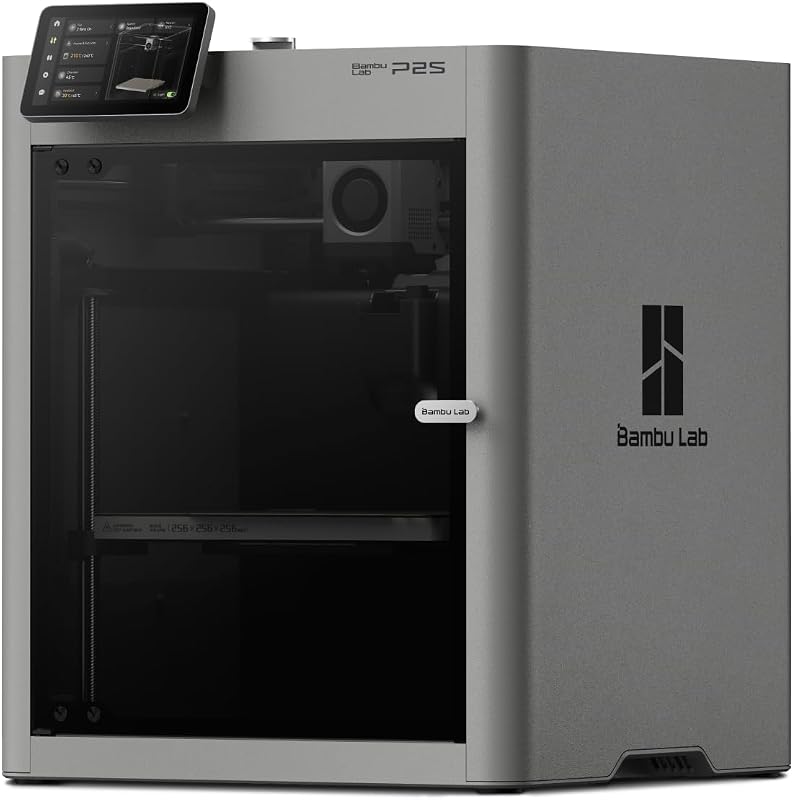
Bambu Lab P2S Combo for Heated Chamber Speed
4.0 Amazon buyer average
Best for: Single-filament engineering parts production
What the listing says
- High-Speed Precision The Bambu Lab P2S 3D printer prints up to 600 mm/s while maintaining exceptional accuracy.
- Ready to Print in 15 Minutes: Set up your P2S FDM 3D printer and start printing in just 15 minutes.
- Effortless Multi-Color Printing The AMS 2 Pro enables seamless multi-color/multi-material 3D printing.
- Smart Airflow for Any Filament: The Adaptive Airflow System automatically balances cooling and heat retention—keeping overhangs…
- Limitless Creativity, Seamless Workflow Explore over one million 3D models on MakerWorld and bring them to life with a smooth,…
Pros
- 600 mm/s print speed
- 50°C heated chamber control
- AI failure detection
Cons
- No multi-color support
- Lacks bundled AMS unit
Best for: High-speed builders wanting filament drying
Pros
- 600 mm/s print speed
- AMS 2 Pro with 65°C drying
- Adaptive 50°C chamber control
Cons
- Large desk footprint
- Heavy 46.3-pound unit
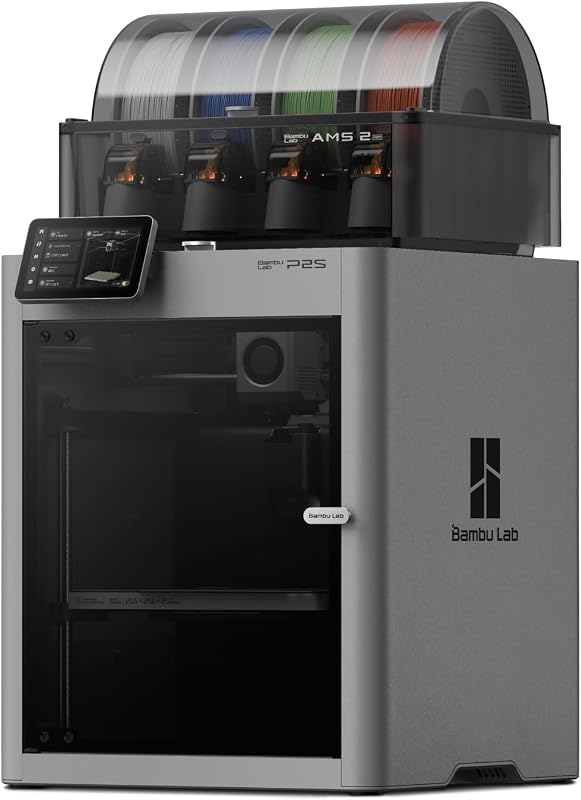
Designed for fast and controlled thermal execution, the Bambu Lab P2S Combo upgrades desktop performance with speeds reaching up to 600 mm/s. The unit features an active PMSM Servo Extruder alongside Active Flowrate Compensation to preserve sharp corners and consistent extrusion across rapid directional changes. Its chassis measures 18 inches deep, 22 inches wide, and 18 inches high, weighing in at 46.3 pounds with a modern grey exterior.
The included AMS 2 Pro system expands multi-material workflows while integrating active filament drying at temperatures up to 65 °C to keep moisture-sensitive spools print-ready. For thermal management, the printer integrates an Adaptive Airflow System that balances cooling for overhangs or maintains a 50 °C chamber environment for engineering plastics. An integrated carbon filter assists in maintaining clean air during operation, while AI failure detection and quick-swap nozzles streamline maintenance.
This setup serves creators producing high-performance structural accessories who require automated multi-spool transitions and active filament moisture control. Operating seamlessly with Windows 10 and smartphone management through Bambu Handy, this bambu lab p2s combo suits advanced users who value rapid calibration alongside unified MakerWorld model access.
No. 3 of 3 · Bambulab
Bambu Lab A1 3D Printer for Bed-Slinger Simplicity
4.1 Amazon buyer average
Best for: Crafters wanting direct-drive Wi-Fi printing
What the listing says
- High-Speed Precision Experience unparalleled speed and precision with the Bambu Lab A1 3D Printer.
- Multi-Color Printing with AMS lite: Unlock your creativity with vibrant and multi-colored 3D prints.
- Full-Auto Calibration Say goodbye to manual calibration hassles.
- Active Flow Rate Compensation Achieve consistently smooth prints with active flow rate compensation.
- Easy and Quiet 3D Printing: Experience effortless printing with the Bambu Lab A1 FDM 3D printer.
Pros
- Direct extruder drive
- 15-minute quick setup
- Wi-Fi app connectivity
Cons
- AMS Lite needed for multi-color
- Open-frame construction

Best for: Beginners needing quiet desktop fabrication
Pros
- Full-auto calibration
- 1-Clip quick swap nozzle
- Active flow rate compensation
Cons
- AMS lite sold separately
- Open bed structure
The Bambu Lab A1 3D Printer presents an accessible, open-format approach to additive manufacturing, making it an appealing bambu lab printer for beginners. Built with hardened steel, stainless steel, and extruded aluminum, this grey machine weighs 10 kg and measures 21.76 inches deep, 20.83 inches wide, and 12.87 inches high. It delivers high-speed printing supported by an acceleration rating of 10,000 mm/s².
Calibration on this unit is completely automated, handling Z-offset adjustments and bed-leveling routines without manual tools. Print quality is reinforced by an Active Flow Rate Compensation algorithm that dynamically manages extrusion pressure. Operation remains quiet and straightforward via a simplified touchscreen interface, and maintenance is simplified with a 1-Clip quick-swap nozzle design that lets makers adjust their hotends quickly.
Beginners, hobbyists, and educators crafting travel organization clips and everyday household items will appreciate the friendly workflow of the bambu lab a1. While multi-color printing is accessible through the AMS lite system, the listing notes that the feeder is not bundled with this standalone model, requiring an upgrade or separate purchase if multi-spool capabilities are desired.
From the notebook
Bambu Lab P2S 3D Printer for Fast Single-Spool Builds
For makers focused purely on single-filament mechanical parts, the standalone Bambu Lab P2S 3D Printer delivers high-end speed in an enclosed configuration. Measuring 18 inches deep, 21 inches wide, and 18 inches high with a weight of 38.9 pounds, this machine trims weight compared to the bundled multi-material version while retaining the same robust grey chassis. It attains speeds up to 600 mm/s powered by its PMSM Servo Extruder and Active Flowrate Compensation.
The enclosed design utilizes the Adaptive Airflow System, retaining a 50 °C internal chamber temperature for technical materials or directing cooling air to stabilize steep overhangs. Safety and air management are handled via a built-in carbon filter. Operational setup requires only 15 minutes, supported by AI failure detection, automatic calibration, and convenient quick-swap nozzles. The listing specifically notes that this standalone bambu lab p2s configuration does not support multi-color printing on its own, as multi-color jobs require the Combo package.
This machine is ideal for utilitarian builders who prioritize high print speeds and enclosed environmental control for single-material functional prints. It handles design transfers and job monitoring smoothly across Bambu Studio, Bambu Handy, and MakerWorld on Windows 10 computers and mobile devices, giving way to the Combo package only when multi-material feeding is necessary.
From the notebook
High-Performance 3D Printer by Bambu Lab for Multi-Color High-Temp Drying
Best for: Advanced high-temperature filament drying
Pros
- 85°C active air drying
- Up to 24 colors capability
- RFID spool synchronization
Cons
- Specialized auxiliary hardware
- Requires compatible computer connection
The High-Performance 3D Printer by Bambu Lab, identified in its product description as the AMS HT high-capacity multi-material printing system, focuses heavily on advanced filament conditioning and material management. Constructed from durable PC and PA polymers, the compact unit weighs 1.21 kg, functioning as a specialized desktop or industrial multi-material management hub that accommodates up to 24 colors across connected hardware.
This system highlights robust conditioning features, including an 85 °C active air vent system driven by electromagnetic technology and a rotating automatic drying mechanism. Smooth material feeding is driven by an internal brushless servo motor, while a dedicated bypass outlet accommodates soft or brittle filaments that struggle in standard feed paths. It also integrates RFID synchronization to automatically apply optimal drying settings for official spools and supports standard STL and OBJ file formats via laptop or personal computer connections.
Makers handling hygroscopic, technical polymers for outdoor gear will find this conditioning hardware highly advantageous. It serves advanced users who already operate compatible printing systems and need reliable high-temperature drying alongside multi-spool deployment, functioning as an auxiliary enhancement rather than an entry-level standalone printer.
From the notebook
Bambu Lab A1 3D Printer for Direct-Drive Wi-Fi Workflows
This configuration of the Bambu Lab A1 3D Printer emphasizes connected convenience and fast assembly. The machine ships ready to use with an advertised 15-minute setup process, utilizing a direct extruder drive for precise filament feeding. Finished in silver, the package measures 24.17 by 20.47 by 12.91 inches with an overall item weight of 8.3 kg, offering a relatively light footprint for desktop workbenches.
Network connectivity is central to this model, featuring swift Wi-Fi integration via Bambu-Bus to enable complete workflow synchronization through the Bambu Studio slicer and the Bambu Handy mobile application. Designed for standard plastic filament printing, the model supports multi-colour printing when paired with an AMS Lite combo, giving users an accessible pathway into expressive visual modeling.
Students, casual makers, and creators who need a dependable machine for rapid concept modeling will find this version practical. It provides reliable wireless job submission and direct extrusion control, making it a great entry point before progressing to heavier enclosed platforms found elsewhere in the lineup of bambu 3d printers.
Before you choose
How to Choose the Right Bambu Lab 3D Printer
Selecting the right model from this lineup requires balancing filament needs, multi-color ambition, and workspace constraints. If your projects involve functional travel components, mounting brackets, or structural cases exposed to heat, an enclosed model like the Bambu Lab P1S Combo or Bambu Lab P2S Combo is ideal. The enclosed build chambers help maintain elevated temperatures—up to 50 °C on the P2S platform—preventing layer separation and warping on technical filaments like ABS and ASA.
For makers primarily working with standard filaments such as PLA or PETG to produce organizers, tabletop models, and lightweight prototypes, the open-frame Bambu Lab A1 provides high acceleration and automated calibration without the bulk of a heavy metal housing. Its direct drive extruder and quiet operation keep tabletop printing hassle-free. When comparing options on our bambulabs 3d printer resource pages, desktop space is often a deciding factor, as open-bed machines are easier to reposition than heavy 40-plus-pound enclosed cabinets.
Multi-color capability is another key consideration. If multi-hue aesthetics or soluble support interfaces are central to your designs, choosing a bundled package like the P1S Combo or P2S Combo saves setup steps compared to standalone units that lack included feeding hardware. When evaluating which bambu lab printer to buy, remember that standalone models like the base P2S do not support multi-color printing right out of the box, requiring the combo version to unlock multi-spool transitions.
Finally, maintenance and long-term care should factor into your decision. High-speed printers rely on smooth mechanical axes, making regular lubrication with quality bambu lab grease beneficial for sustaining peak acceleration. By evaluating your target filaments, color requirements, and physical workshop dimensions against this bambu lab printer comparison, you can select the exact machine that matches your creative workflow.
Questions people ask
FAQ
Which Bambu Lab 3D printer handles high-temperature engineering filaments?
The enclosed models, including the Bambu Lab P1S Combo, Bambu Lab P2S Combo, and standalone Bambu Lab P2S, are specifically designed to manage engineering materials. The P2S models feature an Adaptive Airflow System capable of maintaining a 50 °C chamber temperature, while the P1S is listed as capable of handling PA and PC filaments alongside standard ABS and ASA.
How does the Bambu Lab AMS system manage multi-color printing?
The automated material system routes multiple filament spools into the print head, switching lines automatically during a print. The standard Bambu Lab AMS supports up to 16 colors when multiple units are connected, while the AMS 2 Pro includes built-in filament drying up to 65 °C. Open-frame models like the Bambu Lab A1 utilize the compact AMS lite feeding system.
Is an open-frame Bambu Lab printer suitable for beginners?
Yes, open-frame options such as the Bambu Lab A1 are well suited for newcomers. They feature full-auto calibration for bed leveling and Z-offset, simplified touchscreen interfaces, 1-Clip quick swap nozzles, and direct extruder drives that minimize initial setup complexity.
What setup time should makers expect from Bambu Lab printers?
Most machines across the current lineup, including the Bambu Lab P1S Combo, Bambu Lab P2S series, and Bambu Lab A1, feature ready-to-use packaging that allows makers to complete initial assembly, run automated calibrations, and start printing within approximately 15 minutes.
Can the standalone Bambu Lab P2S print multi-color models without accessories?
No, the product listing explicitly states that the standalone Bambu Lab P2S 3D printer does not support multi-color printing on its own. Users who want multi-color or multi-material capabilities must choose the Bambu Lab P2S Combo version, which includes the AMS 2 Pro unit.
Prices, specifications and the feature lines above are read from the product listing and can change without notice. Every score is the average rating Amazon buyers left for that item; nothing on this page is written from handling the product.