2 models in this file
Textured PEI Plates for Bambu Lab Printers
As Amazon Associates, we earn from qualifying purchases. This means we may receive a small commission at no extra cost to you if you click through and make a purchase.
Bambu Lab printers ship with swappable magnetic build plates, and the textured PEI surface has become the go-to for many owners because it grips PLA and PETG well while hot and releases parts once the bed cools. A spare plate lets you swap mid-session, keep one clean for a critical print, or replace a worn surface. Every plate in this roundup is a third-party plate built to fit Bambu Lab printers, not a Bambu Lab product, and one of them uses “Bamboo Original” in its title even though it comes from another maker.
Five of these plates fit the 257 by 257 mm bed used across the X1, P1 and A1 families, and they differ on thickness, whether both sides are textured or one side is smooth, and QR code support; the sixth is a 184 by 184 mm plate for the A1 Mini.
The line-up at a glance
Textured PEI Plates for Bambu Lab Compared
| Plate | Size | Surfaces | Listed Thickness | Listed Weight |
|---|---|---|---|---|
| Thicker 0.77mm Textured PEI (Wefuit) | 257 x 257 mm | Textured both sides | 0.77 mm | 13.4 oz |
| Upgraded Thicker Textured PEI (SAHVAIM) | 257 x 257 mm | Textured both sides | 0.77 mm | 13.7 oz |
| Dual-Sided Textured/Smooth PEI (COMTREE) | 257 x 257 mm | Textured and smooth | 0.5 mm steel | 1.15 lb (package) |
| PEI Build Plate (UniTak3D) | 257 x 257 mm | Textured and smooth | Not listed | 13.1 oz |
| PEI Build Plate (HENYCEE) | 257 x 257 mm | Textured both sides | 0.77 mm | 13.1 oz |
| A1mini Double Sided PEI (TIOPY) | 184 x 184 mm | Gold smooth plus second surface | Not listed | 5 oz |
Check your printer’s bed size before buying. The 257 mm plates list the X1, X1C, X1E, P1P, P1S and A1, with several adding the X2D and P2S. The A1 Mini needs the 184 mm plate. We compared listings and specifications; we did not print on these plates ourselves.
No. 1 of 2 · Henycee
Thicker 0.77mm Textured PEI Build Plate from Wefuit for Double Textured Printing
8.4/10 Our score

Best for: X2D and P2S owners wanting QR recognition
What the listing says
- Upgraded 0.77mm Thick PEI Print Bed Made from durable flexible spring steel with a total thickness of 0.77mm, this build plate offers…
- Double-Sided Textured PEI Surface Both sides feature a double-sided textured PEI surface that provides strong first-layer adhesion and helps reduce lifting and warping.
- Wide Filament Compatibility The textured PEI surface withstands temperatures up to 300°C and supports PLA, PLA+, PETG, PETG-CF, ABS,…
- Easy Print Removal Once the build plate cools to room temperature, printed models can be removed easily by gently…
- Compatible Models & Easy Cleaning This 257 x 257 mm PEI build plate fits Bambu Lab X2D, P2S, X1, X1C, X1E,…
Pros
- 77mm thick
- Double textured
- QR works on X2D and P2S
- Soap and water cleaning
Cons
- QR not recognized on other models
- No smooth side

Best for: A1 owners printing PLA on smooth side
Pros
- Black textured plus smooth PEI
- Textured side rated 300°C
- Lists X2D and P2S fit
Cons
- Smooth side limited to 200°C
- Glue needed on smooth for non-PLA

Best for: P1S and X1C owners wanting double textured
Pros
- 77mm thick spring steel
- Textured on both sides
- QR code and positioning holes
- Rated to 300°C
Cons
- No smooth side
- QR support by model not stated
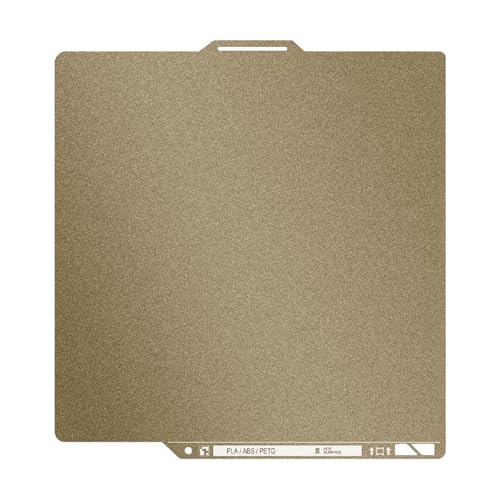
The Thicker 0.77mm Textured PEI Build Plate from Wefuit is a flexible spring steel sheet with powder-sprayed textured PEI on both sides, so you can flip it when one side wears. It has a QR code and positioning holes, and the listing rates the surface for up to 300°C, covering PLA, PLA+, PETG, PETG-CF, ABS, TPU, nylon, PC, PA, ASA and PVA.
It fits 257 by 257 mm beds on the X2D, P2S, X1, X1C, X1E, P1P, P1S and A1. Prints are designed to release without tools once the bed reaches room temperature, and no glue is needed. Clean it with detergent and water; the listing warns that acetone can permanently damage the PEI. It weighs 13.4 ounces.
This suits P1S and X1C owners who print mostly PLA and PETG and want a thicker plate with two usable textured sides. The listing does not say which printers read the QR code, which the HENYCEE plate spells out.
No. 2 of 2 · Sahvaim
Upgraded Thicker Textured PEI Plate 0.77mm from SAHVAIM for Warp Resistance
9.8/10 Our score

Best for: Makers wanting a warp-resistant spare
What the listing says
- Thickened Textured PEI Design For Bambu Lab X2D/P2S/P1S/P1P/A1/X1 Series Textured PEI build plate is made of flexible spring steel plate,…
- High Temperature Resistance The Textured PEI print bed surface is resistant to high temperature 300℃.It is good to print…
- Compatible models The double sided textured PEI build plate compatible for bambu lab 3D printers with 257x257mm platform…
- Strong adhesion and Easy to Remove The Textured PEI spring steel sheet flexible build plate has a good adhesion,no need glue and…
- How to Clean and maintain It is recommended to regularly clean the dust or oil residue on the surface of the…
Pros
- 77mm total thickness
- Both sides textured
- Broad filament list
Cons
- No smooth side
- 7 oz, heaviest 257mm plate
The Upgraded Thicker Textured PEI Plate 0.77mm from SAHVAIM is another double-sided textured spring steel sheet with a total thickness of 0.77 mm. The listing says the extra thickness helps it resist deformation and reduce warping, and both sides can be used.
It carries the same 300°C rating and filament list as the Wefuit plate, fits 257 by 257 mm Bambu beds including the X1-Carbon, X1, X1E, P1P, P1S, A1, X2D and P2S, and includes a QR code. The same cleaning guidance applies: detergent and water, never acetone. At 13.7 ounces, it is the heaviest of the 257 mm plates listed by weight.
This suits makers who want a sturdy double-textured spare and do not need a smooth side. If you want the option of a glossy or matte-smooth bottom finish, the COMTREE or UniTak3D plates below give you one textured and one smooth face.
From the notebook
COMTREE Dual-Sided Textured and Smooth PEI Plate for Two Finishes
The Bamboo Original Dual-Sided Textured Smooth PEI plate is sold by COMTREE. Despite the “Bamboo Original” wording in the title, it is not a Bambu Lab product. One side is textured PEI and the other is a matte smooth PEI sheet that gives the underside of prints a smooth, matte finish.
It uses a 0.5 mm magnetic stainless steel plate for magnetic adhesion and warp resistance. The listing says the smooth side improves Z-axis precision and the textured side gives strong first-layer adhesion without glue, though glue may be needed for some specific filaments. Prints release as the bed cools. It lists the X1C, X1, X1E, P1P, P1S and A1, but not the X2D or P2S, and it does not give a temperature rating.
This suits someone who wants both textured and smooth finishes on one plate. If you print high-temperature filaments often, a listing with a stated temperature rating such as UniTak3D gives clearer guidance. Our guide to the Bambu Lab plate lineup covers other surface types.
From the notebook
UniTak3D PEI Build Plate for Bambu Lab for Textured and Smooth Printing
The PEI Build Plate for Bambu Lab from UniTak3D pairs a black textured PEI side with a smooth PEI side. The listing claims the black textured coating grips more strongly than gold PEI coatings, and says the smooth side gives a very smooth underside that releases without bending the sheet.
It lists different heat limits for each side: 300°C for textured and 200°C for smooth. The smooth side needs glue for filaments other than PLA, and you must peel off its protective film first. UniTak3D advises re-leveling when switching sides and cleaning with a soft cloth. It fits 257 mm beds on the X2D, A1, P2S, P1P, P1S, X1, X1C and X1E, and weighs 13.1 ounces.
This suits A1 and P1S owners who print a lot of PLA and want a smooth option for display pieces. For ABS or nylon on both faces, a double-textured 300°C plate is simpler. Pair it with a roll of Bambu Lab white PLA filament for glossy-bottom parts.
From the notebook
HENYCEE PEI Build Plate for Bambu Lab for X2D and P2S QR Support
The PEI Build Plate for Bambu Lab from HENYCEE is a 0.77 mm flexible spring steel sheet with textured PEI on both sides. The listing claims improved flatness and resistance to deformation, and rates it for 300°C with PLA, PLA+, PETG, PETG-CF, ABS, TPU, nylon, PC, PA, ASA and PVA.
It is the only listing that is explicit about the QR code: recognition works only with the X2D and P2S. It fits 257 mm beds on the X2D, P2S, X1, X1C, X1E, P1P, P1S and A1. Prints release by gently flexing the cooled sheet. Clean with water and mild dish soap, never acetone. It weighs 13.1 ounces.
This suits X2D and P2S owners who want the printer to recognize the plate. On older models, it works as a thick double-textured plate without QR detection.
From the notebook
TIOPY A1mini Double Sided PEI Build Plate for the A1 Mini
Best for: A1 Mini owners packing a spare
Pros
- 184 x 184mm A1 Mini fit
- 5 oz, lightest here
- Gold smooth PEI side
Cons
- Fits A1 Mini only
- Texture description inconsistent
The A1mini Double Sided Textured PEI Build Plate from TIOPY measures 184 by 184 mm for the Bambu Lab A1 Mini’s heated bed. The listing describes a gold-colored PEI coating and a smooth golden side for PLA, PETG and detailed models with glossy bottoms, and names PLA, ABS, PETG, TPU and PC among compatible filaments.
The description is inconsistent: the title says double-sided textured, while the features describe two textures including a smooth golden side, without clearly describing the second face. It clips onto the bed, releases prints once cool, and cleans with isopropyl alcohol. It weighs just 5 ounces.
This is the only choice here for A1 Mini owners. Its small size and weight also make it easy to carry to a maker space alongside a Bambu Lab tool kit.
Before you choose
How to Choose the Right Textured PEI Plate for Bambu Lab
Start with bed size. The A1 Mini needs a 184 mm plate. Every other Bambu model in these listings uses 257 mm, but check that your specific printer appears in the compatibility list; the COMTREE plate does not list the X2D or P2S.
Next, decide on surfaces. Double-textured plates from Wefuit, SAHVAIM and HENYCEE give two grippy sides. The COMTREE and UniTak3D plates swap one textured side for a smooth side, which changes the finish on the bottom of prints and may need glue for some filaments.
Then look at heat. The textured sides are rated to 300°C, which covers engineering filaments. UniTak3D rates its smooth side at 200°C. COMTREE does not state a rating.
Finally, consider thickness and QR support. The 0.77 mm plates claim better flatness. Only HENYCEE states which printers read its QR code.
Questions people ask
FAQ
Are these plates made by Bambu Lab?
No. All six are third-party plates designed to fit Bambu Lab printers, including the COMTREE plate that uses “Bamboo Original” in its title.
Which textured PEI plate fits the P1S?
All five 257 by 257 mm plates list the P1S.
Can I clean a PEI plate with acetone?
No. The Wefuit, SAHVAIM and HENYCEE listings warn that acetone can permanently damage PEI. Use soap and water, or isopropyl alcohol for the TIOPY plate.
Is there an A1 Mini textured PEI plate here?
Yes. The TIOPY A1mini plate measures 184 by 184 mm for the A1 Mini.
Do I need glue on a textured PEI plate?
The listings say textured surfaces generally do not need glue, though COMTREE notes some specific filaments may. UniTak3D says its smooth side needs glue for anything other than PLA.
Prices, specifications and the feature lines above are read from the product listing and can change without notice. Scores are out of 10, based on listed specifications and buyer feedback; nothing on this page is written from handling the product.


